
Dwaipayan Bose on how index funds play a key role in the diversification of portfolios and help manage risks

The Nifty had added more than a hundred points in the past two trading sessions, and infact, comprehensively crossed the 5500 mark on Thursday. The market breadth was negative. Of the 3,071 shares traded on the BSE, 1,602 stocks have declined while 1,353 have advanced.

'In the next one-and-a-half, two months you'll get decent amount of opportunities in the mid-cap and small-cap sector at lower levels.'

Foreign portfolio investors have been net positive since the Union Budget

From the Sensex pack, IndusInd Bank, Mahindra & Mahindra, PowerGrid and Bajaj Finserve gained up to 2.01 per cent. On the other hand, bellwether stocks such as ITC, Kotak Mahindra, Tech Mahindra and Reliance were the laggards. ITC shares closed the session with a loss of 3.87 per cent lower and Reliance ended 1.92 per cent lower.

The focus is on corporate results at one level but global news will also have an impact

rediffGURU Nikunj Saraf suggests considering small-cap, mid-cap, and multi-cap mutual funds.

Global trends, macroeconomic data, and the outcome of the US Fed policy meeting are the major factors that will drive the movement in the domestic equity markets this week, analysts said. "In the upcoming data-centric week, the focus will be on crucial releases, including inflation data from India and the US. "Indian inflation is expected to rise, while US inflation will remain steady.

rediffGURU Ulhas Joshi recommends five factors you need to look at to evaluate the performance of two schemes.

Boom, bust or a bit of both: as the jury bides time before ruling on the US 'recession', the economy's vital signs at a perplexing time of high-interest rates, still-punishing inflation, and surprisingly strong economic gains are a study of a growing debate over whether the world's largest economy is barrelling into a new downturn. With the US Federal Reserve's (Fed's) inflation fighters attempting the risky pursuit of 'pillow-soft landings' and its economy sending out mixed signals, if there is indeed a recession, it could spell trouble for domestic equities and corporate earnings growth.
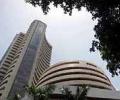
The Sensex ended below 17,500 on Wednesday amid profit taking in index heavyweights after sharp gains on Wednesday that saw the benchmark index ending at a 4-month closing high. Weakness in Europe also dampened sentiment.
The recent rally in small and midcap (SMID) stocks is not backed by fundamentals and is a case of irrational exuberance, analysts at Kotak Institutional Equities said in a recent report. The fundamentals of most of these companies have, in fact, worsened over the last few months, they noted. Yet, some analysts expect the bull run in these stocks to continue amid intermittent corrections.

rediffGURU Ulhas Joshi answers your mutual fund queries.

'In the short term you keep your return expectations very, very low; in the medium term be prepared to invest and in the long term growth will come and your returns from stocks will be high.'

The current valuation is 38 per cent higher than the 10-year average of 22x and over 50 per cent higher than the 20-year average of around 20x.

NIFTY appears determined to retest the break point as support, which is a healthy sign -- provided it holds. Should it do so, NIFTY too will join the other markets to reach for new highs, says Sonali Ranade

HCL Tech was the top gainer in the Sensex pack, rising over 4 per cent, followed by HDFC Bank, Infosys, NTPC, Nestle India, TCS and HUL. NSE Nifty surged 337.80 points to 14,845.10.

In the US, the ratio of the CEO to average worker pay ratio was 373:1 in 2014.

At a time when investors are preferring higher-risk investment products like thematic and small-cap mutual fund (MF) schemes, some fund houses are exploring the possibility of going further down the market-capitalisation (m-cap) ladder to unearth newer investment opportunities. HDFC MF had filed papers with the capital markets regulator - the Securities and Exchange Board of India (Sebi) - earlier this year for an active micro-cap scheme. Some more fund houses are keen on launching such schemes, say industry observers.

From the Sensex pack, Infosys, Hindustan Unilever, Reliance Industries, ICICI Bank, Larsen & Toubro, Asian Paints, Nestle, Axis Bank, Wipro and Kotak Mahindra Bank were the major gainers. JSW Steel, State Bank of India, Tata Steel, Bajaj Finserv, UltraTech Cement, IndusInd Bank, Tata Motors and Bajaj Finance were the major laggards.
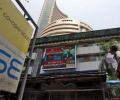
Benchmark indices Sensex and Nifty declined in early trade on Wednesday due to selling in financials, oil and IT stocks amid weak global trends.

The Indian markets have seen a good run in the last three months with the S&P BSE Sensex rising around 7 per cent and the Nifty50 moving up 7.5 per cent. The next leg of the market rally from here on, analysts suggest, will be driven by a growth in corporate earnings over the next few quarters. That said, they do not expect material / sharp downgrades to India Inc's earnings estimates despite headwinds for the economy.

If a 5% to 10% fall in the equity market gives you sleepless nights, you are not cut out for a 75% to 80% allocation to equities and must reduce it.

Since the Budget announcement on July 5, FIIs have been busy unloading their stock.

Rakesh Jhunjhunwala has picked up a 1.29 per cent stake in Tata Motors. The September quarter shareholding pattern disclosed by the automaker showed Jhunjhunwala holding 40 million shares.

The dealers operating in the space have jumped nearly three times over the past two years.

Analysts said FIIs had created long positions worth Rs 9,700 crore (Rs 97 billion) in index futures till recently.

The Sensex created history by crossing the 8,500-mark today.

'Sectors that had been left out till now will also start participating in the rally.'

HCL Tech and ONGC were the top gainers in the Sensex, rising up to 3.40 per cent.

'Investing in a factor-based fund can be beneficial provided you have chosen the right factor.'

rediffGURU Ramalingam Kalirajan answers your personal finance queries.

The markets will remain choppy ahead of RBI policy.

The market is moving up because there is a high degree of speculative retail and operator action. This is rarely a situation sustainable for any lengthy period, says Devangshu Datta.

Tech Mahindra and United Spirits will replace them in the 50-share index of the National Stock Exchange with effect from March 28.

A tally around 150 in Gujarat can see the index hit 10,700 levels going ahead

Two equity funds at the opposite ends of the risk matrix - small-cap and arbitrage - bucked the 'low inflow' trend in May this calendar year 2023 (CY23) to receive the highest net inflows in recent years. The Rs 3,280-crore net inflows into small-cap schemes in May was the highest for the category since the mutual fund (MF) industry started releasing fund-wise inflow data in April 2019. Arbitrage schemes raked in a net Rs 6,640 crore - the highest since July 2021.

Yes Bank and Tata Motors were the biggest losers in the Sensex pack, slumping 8 per cent.
